
Interfacing with Hardware
Interfacing with hardware is a crucial aspect of programming, especially in embedded systems and low-level programming. In this chapter, we'll delve into how to communicate with hardware devices using the C programming language. From basic input/output operations to more advanced topics like device drivers, we'll cover everything you need to know to interact effectively with hardware.
In C, basic input/output operations are performed using standard functions provided by the C Standard Library, such as printf() and scanf(). However, when it comes to interfacing with hardware, we often need to work with specific hardware registers or memory-mapped I/O.
Memory-Mapped I/O
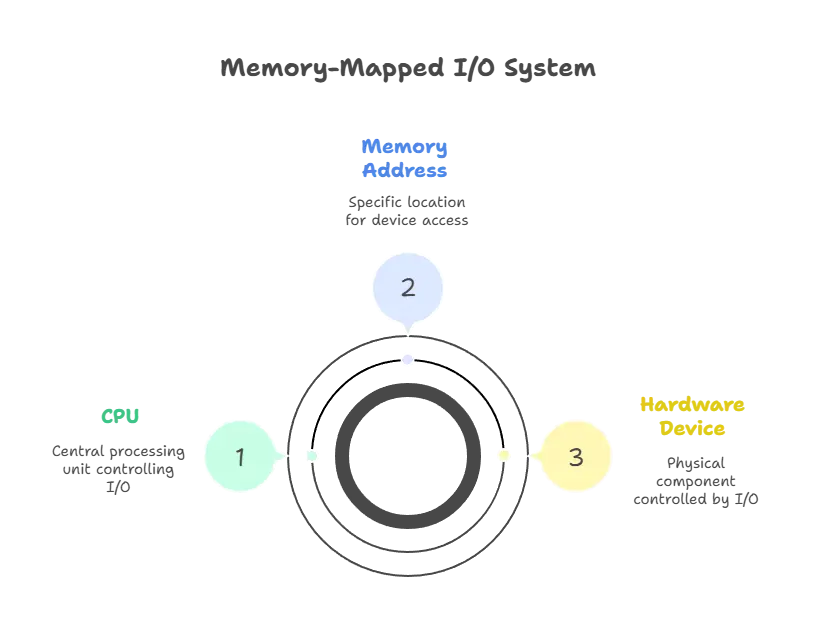
Memory-mapped I/O is a technique where hardware devices are mapped to specific memory addresses, allowing direct access
- Concept: Hardware components are assigned memory addresses. C code can directly read from and write to these addresses to control the device.
- Example: Consider a light-emitting diode (LED) connected to a specific memory address. Writing a 1 to that address turns on the LED, while a 0 turns it off. from the CPU. Let’s understand this with an example
					#include <stdio.h>
#define LED_ADDRESS 0x1234 // Replace with actual LED memory address

int main() {
    int* led_ptr = (int*)LED_ADDRESS;

    *led_ptr = 1; // Turn on LED
    printf("LED turned on\n");

    *led_ptr = 0; // Turn off LED
    printf("LED turned off\n");

    return 0;
}
					// output (Hardware) //
LED turned on
LED turned off
I/O Ports
- Concept: In some architectures, hardware is accessed through dedicated I/O ports instead of memory addresses. C code interacts with these ports using special functions provided by the compiler or libraries.
- Example: Imagine serial communication through a COM port. C code would employ functions like
fopen()andfprintf()to interact with the port for data exchange.
					#include <stdio.h>

int main() {
    FILE* com_port = fopen("COM1:", "w"); // Replace with actual port name
    if (com_port == NULL) {
        printf("Error opening COM port\n");
        return 1;
    }

    fprintf(com_port, "Hello from C!\n");
    fclose(com_port);

    return 0;
}
					// output (Hardware) //
Transmits "Hello from C!" to the serial port
(no visible output on the screen).
Advanced Techniques
Bit Fields:
- Concept: Hardware registers often contain multiple flags or control bits. Bit fields allow C to manipulate individual bits within a register.
- Example: A register might control LED brightness through several bits. Bit fields let you set or clear specific brightness levels.
					#include <stdio.h>

struct LED_control {
    unsigned int bit0 : 1; // Brightness level 0
    unsigned int bit1 : 1; // Brightness level 1
    unsigned int : 6;    // Unused bits
};

int main() {
    struct LED_control* led_reg = (struct LED_control*)0xABCD; // Replace with actual register address

    led_reg->bit0 = 1; // Set brightness level 0
    led_reg->bit1 = 0; // Clear brightness level 1
    printf("LED set to medium brightness\n");

    return 0;
}
					// output (Hardware) //
Sets the LED to a specific brightness level (hardware-dependent).
Important Considerations
- Hardware-Specific Details: Hardware interfacing is highly dependent on the specific hardware platform and its architecture. Always consult the device documentation for memory addresses, I/O ports, register configurations, and available control functions.
- Compiler/Library Support: Different compilers and libraries may provide varying
Interrupts:
- Concept: Interrupts allow hardware devices to signal the processor for attention, enabling efficient handling of asynchronous events. C code sets interrupt service routines (ISRs) to handle these signals.
- Example: A button press could trigger an interrupt. The ISR would read the button state and perform actions like turning on an LED or sending data.
Direct Memory Access (DMA)
DMA allows for high-speed data transfer between memory and devices without involving the processor. C code configures the DMA controller for data movement, improving performance for large data transfers.
Timers and Counters
Hardware timers and counters generate timing signals or keep track of events. C code interacts with these units to implement delays, time measurements, and pulse-width modulation (PWM) for LED dimming or motor control.
					#include <stdio.h>
#include <time.h> // For timer functions

int main() {
    clock_t start_time = clock();

    // Perform some time-consuming task here

    clock_t end_time = clock();
    double elapsed_seconds = (double)(end_time - start_time) / CLOCKS_PER_SEC;

    printf("Elapsed time: %.2f seconds\n", elapsed_seconds);

    return 0;
}
					// output //
Prints the time elapsed since clock() was called
(implementation-dependent).
Analog-to-Digital Converters (ADCs) and Digital-to-Analog Converters (DACs)
ADCs convert analog signals (e.g., voltage from a sensor) into digital values readable by C code. DACs perform the reverse, converting digital values into analog signals (e.g., for controlling sound or light intensity). C programs interface with these devices to acquire sensor data and generate analog outputs.
Developing Embedded Systems with C
- Microcontrollers and Embedded Systems: Microcontrollers (MCUs) are self-contained computers designed for embedded applications. C excels at programming MCUs due to its efficiency and direct control over hardware.
- Development Tools and Libraries: Embedded system development often involves specialized tools like cross-compilers (compiling for the target MCU architecture) and libraries for hardware interaction. Consider tools like Arduino IDE, Keil MDK, or IAR Embedded Workbench.
- Embedded System Design Considerations: Design for resource constraints is crucial in embedded systems. Optimize code for memory usage, power consumption, and real-time performance (guaranteeing tasks within deadlines).
C empowers you to create powerful and interactive applications by enabling direct communication with hardware. This chapter has delved into various techniques, from basic memory-mapped I/O to advanced topics like interrupts and DMA. Remember to consult hardware documentation and utilize appropriate tools and libraries for successful embedded system development.Happy coding!❤️